
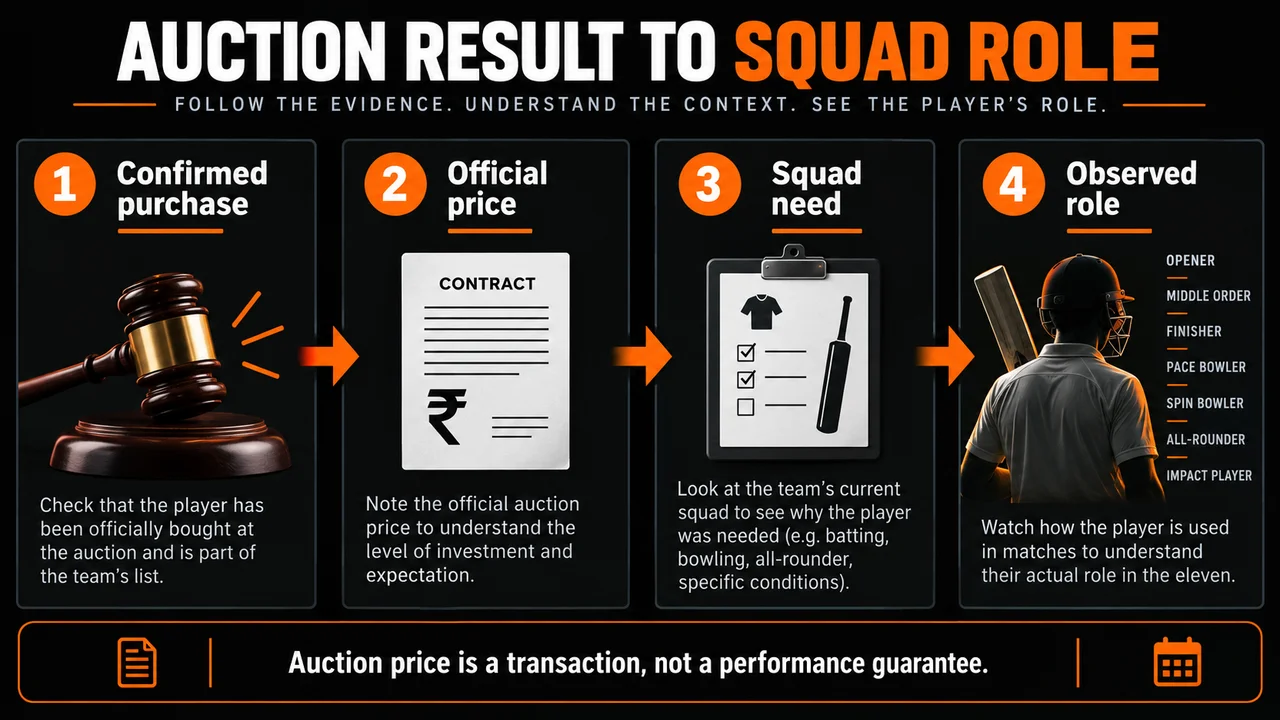
A large auction bid answers one question: how much a franchise was prepared to commit at that sale. It does not answer whether the player filled its most urgent need, played the expected role or justified the price across a season. This IPL 2026 auction review separates those questions so that a headline purchase does not become an unsupported verdict on a team.
Reviewed on 4 October 2026. The auction is a completed event. Figures below belong to the published pre-auction snapshot, not to a live purse or an estimate for the next auction. Use the official auction record for the purchase, then match records for the player’s contribution.
Start with the resources each team actually had
The IPL retention announcement of 15 November 2025 placed Kolkata Knight Riders and Chennai Super Kings in very different rebuilding positions from Mumbai Indians. The following selected figures are useful because they show the room to add players before bidding began. They cannot be reused as balances after the sale.
| Team | Pre-auction purse, ₹ crore | Maximum open squad slots |
|---|---|---|
| KKR | 64.30 | 13 |
| CSK | 43.40 | 9 |
| MI | 2.75 | 5 |
Source: IPL, 15 November 2025; selected teams only. A squad slot and an overseas slot are different constraints. A team can have money available while still having little practical room for a particular type of overseas signing. Equally, a small purse may reflect an expensive retained core rather than a lack of ambition.
One confirmed headline, three separate questions
The league’s official auction video records Cameron Green’s ₹25.20 crore bid. KKR’s 16 December 2025 auction report confirms the acquisition and its other purchases. Treat the bid, the role and the subsequent contribution as three separate records, with the first supported by the auction and the other two by team selection and match evidence.
| Selected KKR purchase | Confirmed price | Squad question to investigate |
|---|---|---|
| Cameron Green | ₹25.20 crore | Which batting position and bowling workload followed? |
| Matheesha Pathirana | ₹18 crore | How was the overseas bowling combination selected? |
| Tejasvi Singh | ₹3 crore | What playing opportunity followed squad membership? |
Source: KKR auction report, 16 December 2025. The questions are editorial follow-up tasks, not the franchise’s stated motives. These prices belong to the auction snapshot and do not establish later availability, fees or current team membership.
For an all-rounder, the role question is especially important. Was the player selected primarily for batting, did he bowl regularly, and which existing player made way? An all-rounder label does not mean the player bowled four overs in that match. Reviewing the match scorecard prevents a nominal all-rounder from being counted twice when comparing squad balance.
| Question | Record to inspect | Conclusion to avoid |
|---|---|---|
| Was the purchase confirmed? | Dated league auction record | A rumour became a signing |
| Did it fill a role? | Actual batting position and bowling use | A listed all-rounder always filled both jobs |
| Did the season support the plan? | Appearances and comparable match samples | Price alone explained wins or losses |
Reconstruct the squad in the right order
Build the retained squad first, add confirmed auction purchases second, and then record replacements and trades as later changes. The order matters: a player acquired in a later replacement announcement cannot explain what a team was trying to do with its original auction purse. Preserve the date next to every change instead of presenting one blended list as an auction result.
Use the retention and trade news guide to distinguish these transaction types. Then compare the resulting positions in the IPL 2026 team review. Start with the auction record to confirm the signing, then the team review to examine the available roles.
Test a squad need without inventing a ranking
Suppose a side appeared to need a second wicketkeeper. That is an editorial hypothesis until you inspect the retained squad, overseas availability and the combinations it could field. A keeper who rarely enters the XI may still provide injury cover. An expensive batter can improve depth while leaving a bowling shortage untouched. These are different outcomes, and neither is captured by calling the auction a winner or loser.
A practical comparison records one primary need, the confirmed acquisition connected to it, the opportunity the player received and the remaining uncertainty. Keep the uncertainty specific: selection competition, a short sample or an unavailable record. Do not replace missing evidence with a claim that the team bought leadership, momentum or a guaranteed advantage.
What this review does not establish
The headline above is a selected verified example, not a complete winning-bid table. The standalone 2026 auction page could not be retrieved during this check, so this article does not reconstruct every purchase from secondary lists. Follow official transaction notices when you need an individual confirmation. A bid can be historically accurate while an old profile’s team affiliation has since changed.
For developing players, the young-player opportunity tracker asks what playing time followed squad membership. That next step is more useful than treating an auction price as a forecast of runs, wickets or betting returns. Match evidence can support a limited cricket judgment; it cannot establish a reliable financial edge.
Editorial method: AI-assisted source review checked official records on 4 October 2026. Tables distinguish documented facts from questions still requiring match or event evidence. No first-hand player, coaching or ticket-purchase experience is claimed.