
Scheduled August 2026 editorial note: IPL Batter-Bowler Matchups: Sample Size, Role, and Match Situation is an educational guide for readers who want a clearer way to check batter-bowler matchups. It is not a prediction, a signal service, or a promise about an outcome. When a material source or rule is unclear, pausing is a valid result.
Direct answer: Compare a batter-bowler matchup by checking the sample size, the time period, the player’s current role, and the match situation. A historical matchup can be a useful question to investigate, but it is not a standalone prediction and should not be presented as one.
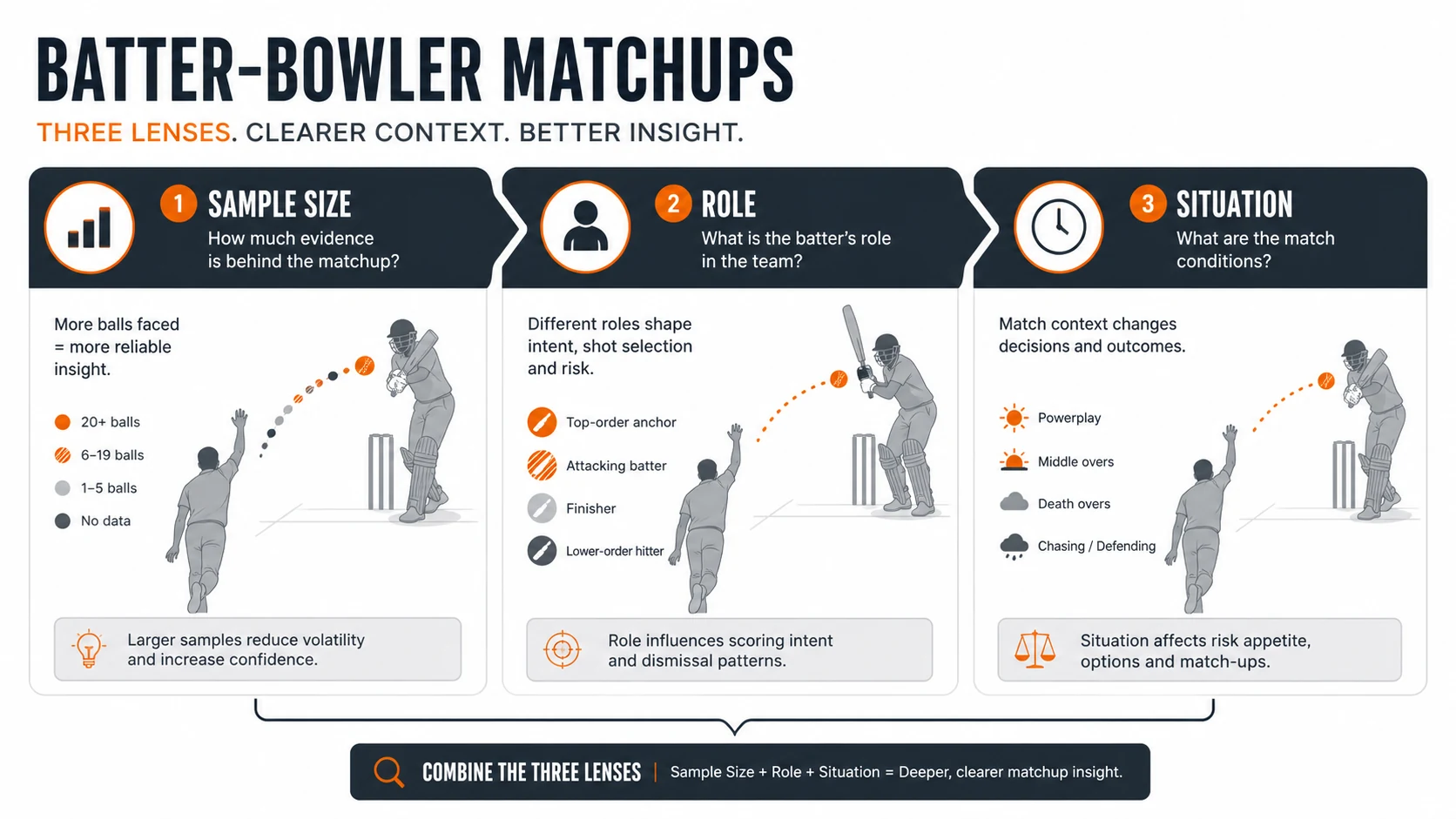
A matchup number becomes more informative when its sample and role context are visible. A small number of balls can produce a memorable statistic. That number may also come from an old season, a different role, or a very different venue. The reader needs to know what was counted before deciding whether the comparison answers the question they actually have.
The direct answer in practice
For the question “IPL batter bowler matchups,” start with the source and the exact time or competition context. Then name the fact that can be checked, the interpretation that remains conditional, and the limit that keeps the reader from turning an incomplete update into a confident story. This three-part note is short enough to use and specific enough to review later.
The point is not to make cricket information look more certain than it is. A scorecard, rule page, confirmed XI, data table, or current term can answer a narrow question. It cannot answer every question around the match. Keeping the scope visible is part of good editorial work.
| Reader question | Evidence to open | Useful output | Pause signal |
|---|---|---|---|
| Sample | Balls, innings, dates, competition | Shows how much data exists | Leading with a percentage only |
| Role | Current batting or bowling use | Connects data to the player | Assuming last season’s role |
| Situation | Phase, venue, score, weather | Explains when the data arose | Removing match state |
| Limit | Missing or conflicting records | Keeps the claim honest | Calling a small sample decisive |
How the Matchup Evidence Card works
The first step is to define the unit being discussed. That may be a score, an over, a player role, a rule version, a price, or a personal limit. The definition prevents a familiar label from carrying more meaning than the source gives it. Record the source, date, and sample before writing the interpretation.
The second step is to compare like with like. A current match should not be explained only with an old scorecard. A player in one role should not be compared with the same player in a different role without saying so. A competition rule should not be borrowed from another season. The comparison is only as clear as the boundary around it.
The third step is to write what would change the note. A confirmed team sheet may replace an expected lineup. A new rule update may replace an old explanation. A missing source may mean there is nothing responsible to conclude. Stating the change condition gives the reader a natural stop point and makes later corrections easier.
| Step | Reader action | Evidence signal | What not to do |
|---|---|---|---|
| Define | Name the unit and period | Source and date are visible | Use a vague label |
| Compare | Use matching samples and roles | Differences are explained | Mix unlike records |
| Update | Record what would change | A stop point exists | Extend the claim automatically |
| Limit | State what remains unknown | Uncertainty is readable | Turn context into certainty |
A worked example
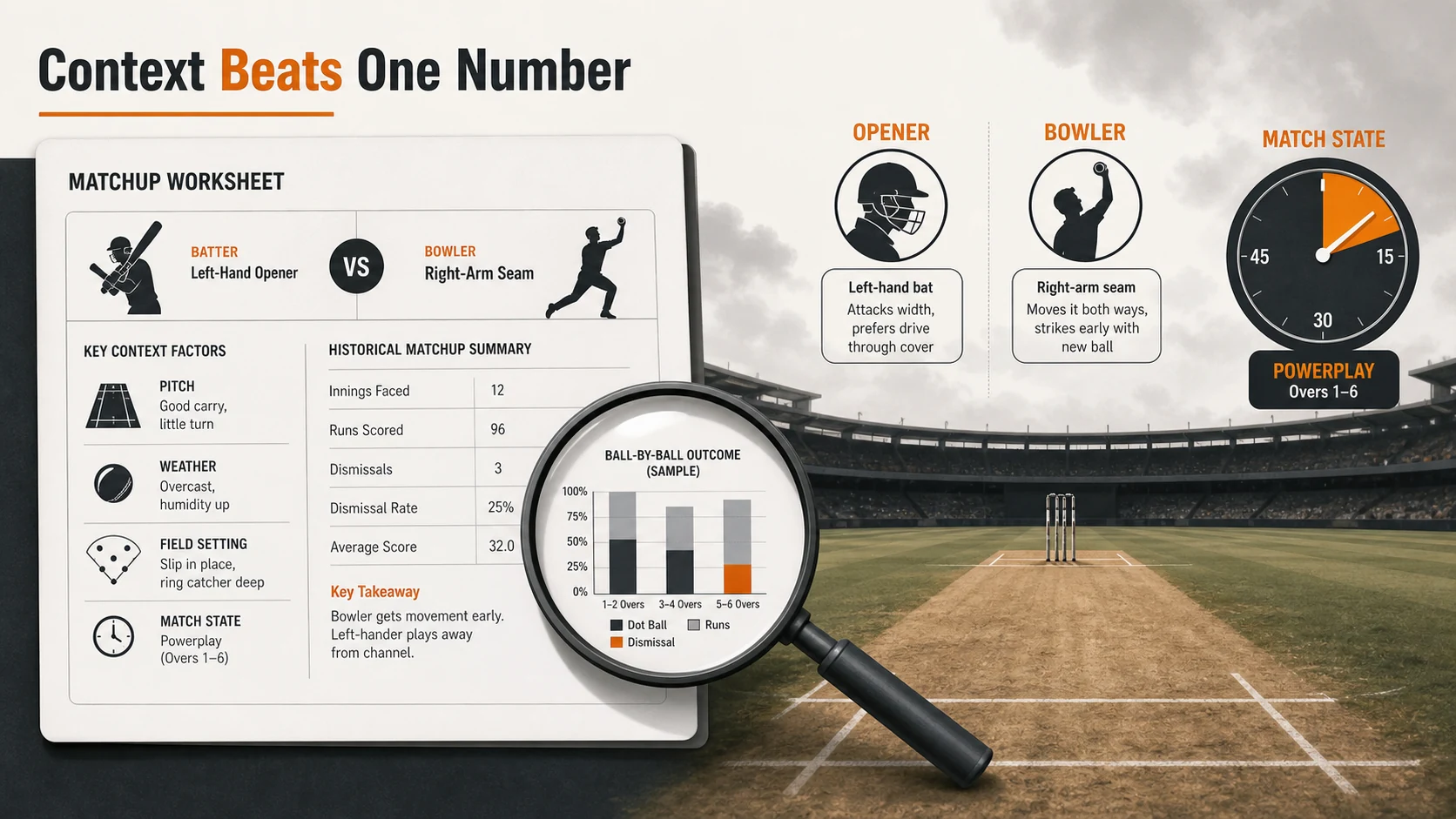
A batter may have scored quickly against a bowler across two old matches, but the current team may use that batter as an anchor and the bowler only during the powerplay. The historical line is still a fact worth checking. It is not the same as knowing how the next meeting will unfold.
The example is intentionally conditional. It shows how a reader can move from a source to a bounded observation without pretending to know the result. The same discipline applies when the information is exciting, contradictory, or arriving close to the start of a match. The more pressure a screen creates, the more valuable a short written boundary becomes.
A five-point checklist
- Save the source and denominator.
- Separate historical data from current role.
- Check the relevant match phase and venue.
- Compare more than one meaningful context field.
- Remove any conclusion the evidence cannot support.
Use the checklist as a sequence, not as a collection of keywords. If the first source is missing, do not compensate by adding more commentary. If the rule is unclear, do not replace it with memory. If the personal boundary is already being negotiated, treat that negotiation as information and take the planned break.
What this method cannot tell you
Do not hide sample size behind a rounded percentage. Different data providers can classify deliveries, dismissals, or competition phases differently. Cite the source, preserve the denominator, and label the comparison as historical context when current role or availability is uncertain.
No article can remove the uncertainty in a live sporting event or make a platform term permanent. Current information should be rechecked at the point where it matters. The reader should also respect age, regional, legal, financial, and account requirements that apply in their location and on the service they use.
| Situation | Useful response | Evidence boundary |
|---|---|---|
| Source is current | Record it and answer the narrow question | Do not broaden the claim |
| Source is old | Find the current version | Label the old page as background |
| Sources disagree | Keep definitions and dates visible | Do not choose for convenience |
| Reader feels urgency | Use the stop rule and pause | Urgency is not evidence |
Sources, responsibility, and update note
For cricket information, start with the named IPL source and the competition’s current page. For responsible-use context, see NCPG help and treatment information and GambleAware safer-gambling guidance. These sources help frame verification and personal limits; they do not decide a match or a market for the reader.
Vegas11 Sport may include commercial or affiliate references. Review the Affiliate Disclosure, Editorial Policy, Review Methodology, Responsible Gaming, and Corrections Policy. Terms, availability, fixtures, data, and rules can change. Check current information and local requirements before acting.
FAQ
Is batter-bowler matchups a prediction?
No. It is a way to organize current evidence and keep the claim within its real boundary. The method is useful even when the correct conclusion is that the information is incomplete.
What should I do when a source changes?
Save the new date, replace only the affected line, and note what changed. If the change affects a material rule, role, or limit, pause before taking any further step.
What is the clearest stop signal?
An unverified material fact, an unclear active rule, a missing timestamp, or a feeling that the session must continue is enough. A reader does not need to create a stronger reason to step away.
Editorial takeaway
A matchup number becomes more informative when its sample and role context are visible. The practical standard is modest: the reader should leave knowing what was checked, what remains conditional, and where to look for help or correction. That is more valuable than a louder conclusion.
Source and update note: Prepared for scheduled publication in August 2026. Recheck the named competition source, current terms, and responsible-use information before relying on any time-sensitive detail. Author: Vegas11 Sport Editorial Desk. Review focus: source clarity, evidence limits, and responsible-use wording.