
A useful IPL 2026 player review separates season output from a memorable innings. Vaibhav Sooryavanshi and Kagiso Rabada led the official run and wicket summaries, while Virat Kohli produced the decisive batting contribution in the final. Those records answer different questions; none should be stretched into a universal player ranking.
Start with the recorded sample
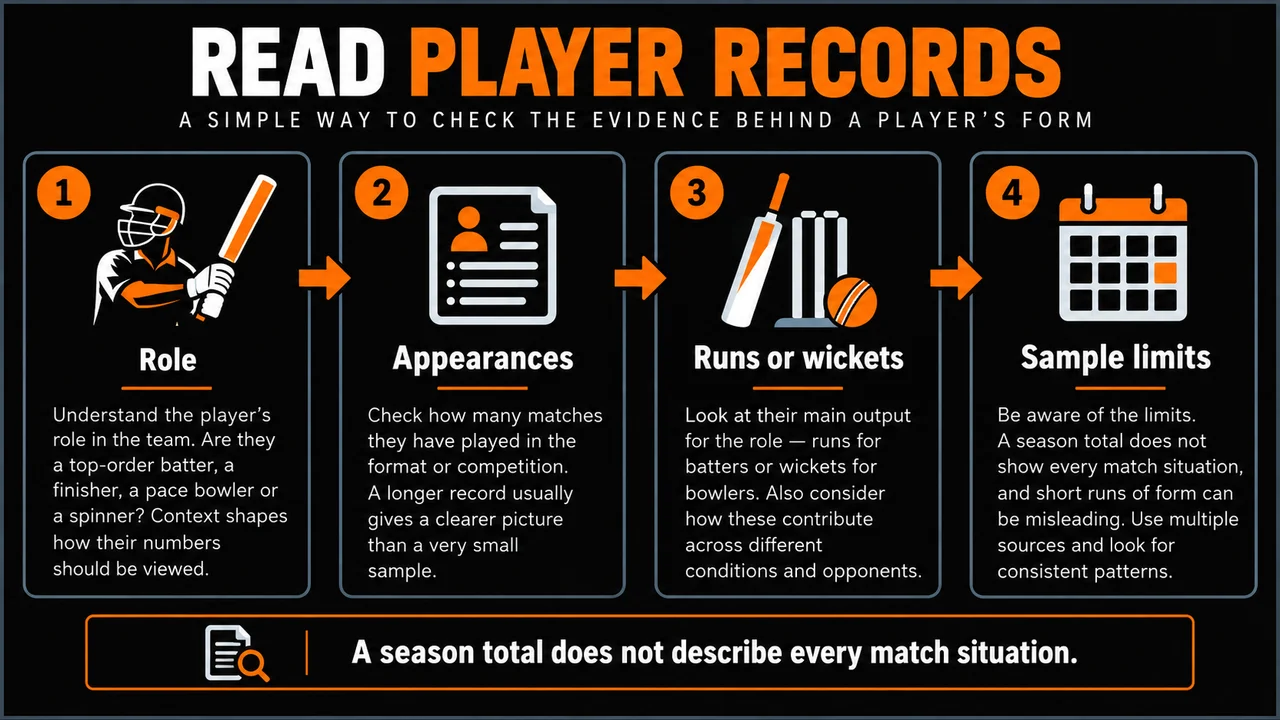
The official IPL 2026 season summary lists Sooryavanshi with 776 runs from 16 matches and Rabada with 29 wickets from 17 matches. These are season totals with visible appearance counts. They establish output, but do not give every role, phase or opponent breakdown needed for a complete comparison.
| Player | Verified record | Scope |
|---|---|---|
| Vaibhav Sooryavanshi | 776 runs; 16 matches | Official 2026 season summary |
| Kagiso Rabada | 29 wickets; 17 matches | Official 2026 season summary |
| Virat Kohli | 75 not out from 42 balls | 2026 final only |
| Venkatesh Iyer | 32 from 16 balls | 2026 final only |
The final batting lines come from the official RCB–GT report. They are included as match examples, not season statistics. Keep match figures and season totals in separate columns so readers can compare the same sample.
What a batting total leaves out
Runs tell you how much a batter contributed to the score, but the opportunity matters. An opener can face more deliveries than a player arriving near the end. A finisher’s short innings may serve a different task from an opener’s long stay. Record balls faced, dismissals and entry position before comparing them.
Batting average uses dismissals as its denominator; strike rate uses balls faced. A not-out changes the average calculation without erasing the deliveries played. When no dismissal appears in a sample, do not replace an undefined average with an invented number. Keep the raw runs, balls and dismissal count beside the rate so another reader can check it.
Work through the final example
Kohli’s 75 from 42 balls gives a strike rate of approximately 178.57: 75 divided by 42, multiplied by 100. Iyer’s 32 from 16 gives 200. That does not make Iyer’s entire contribution more valuable by definition. They faced different portions of the chase and remained at the crease for different lengths of time.
| Calculation | Result | What it does not tell you |
|---|---|---|
| 75 ÷ 42 × 100 | 178.57 runs per 100 balls | How difficult every delivery was |
| 32 ÷ 16 × 100 | 200 runs per 100 balls | The player’s season strike rate |
| 29 wickets ÷ 17 matches | About 1.71 wickets per match | Bowling average or wickets per over |
Bowling comparison needs its own denominator
Wickets per match can summarize output, but matches do not describe how many overs a bowler delivered. Bowling average needs runs conceded and wickets; economy needs runs conceded and legal balls expressed as overs. Keep the phase visible as well. Bowling with a new ball and bowling at the end of an innings can involve very different demands.
An appearance count shows how often the player had a chance to contribute. A high total across many appearances and a high rate across a few appearances are distinct findings. Neither should be concealed behind a label such as “match winner.” Start with the measurable record, then explain the circumstances that could change its interpretation.
Show the inputs behind each rate
Write down the season filter, source, player role and sample before computing a rate. Use one definition across the table. If you add playoffs, include them for every player whose record you compare. If an official page changes, retain the checked date with your notes instead of silently treating the old extraction as live data.
The player data guide explains source and sample checks in more detail. Our team comparison places individual roles back in the lineup. The young-player guide focuses on opportunities and limited evidence rather than repeating this season-output table.
What this review supports
You can identify verified leading totals and recalculate the final examples. You cannot infer a future outcome, a transfer decision or a player’s performance in an unobserved role from these figures. If the required balls, overs or appearances are missing, state the limit and stop the comparison at the evidence available.
Sources: IPL season summary and IPL final report, checked for the 2026 archive. Calculations are shown explicitly; no invented season average or unverified ranking is included.
Updated 4 October 2026. Prepared with AI assistance; source checks use the official records linked above. Calculations and interpretations are identified separately from match facts.