
The umpire calls a no-ball, the batter hits the next delivery high in the air, and a fielder catches it. Does the batter have to leave? In a match governed by the ICC men’s T20I conditions effective from October 2026, if the no-ball call stands and another delivery is bowled in the innings, it is a free hit and a catch alone cannot dismiss the striker. A run-out can still be possible. First check the rules of the actual match: a free hit is a playing condition, so do not assume every competition uses the same one.
The MCC Laws set the general no-ball framework. The examples below use the ICC men’s T20I conditions effective October 2026 when they discuss a free hit. They are not a substitute for an IPL season’s own conditions.
What a no-ball changes immediately
A no-ball can be called for different infringements. A front-foot fault is one example; it is not the only possible reason. Once the call is made, the ball does not automatically become dead. Unless the call is revoked under the applicable conditions, a one-run no-ball penalty is added to the batting side’s score. Other runs can also be scored, subject to the rules governing the event.
Under the cited T20I conditions, a no-ball does not count as one of the valid balls in the over. The penalty is recorded as a no-ball extra and debited to the bowler. If a score display has not yet updated, check the official scorecard and the umpire’s signal before reconstructing the delivery.
The next delivery under the ICC men’s T20I example
Under clause 21.18, the next delivery after a no-ball is a free hit if the call stands and another delivery is bowled. The identity of the striker can change between the deliveries; the free hit belongs to the next delivery, not permanently to the batter who faced the no-ball.
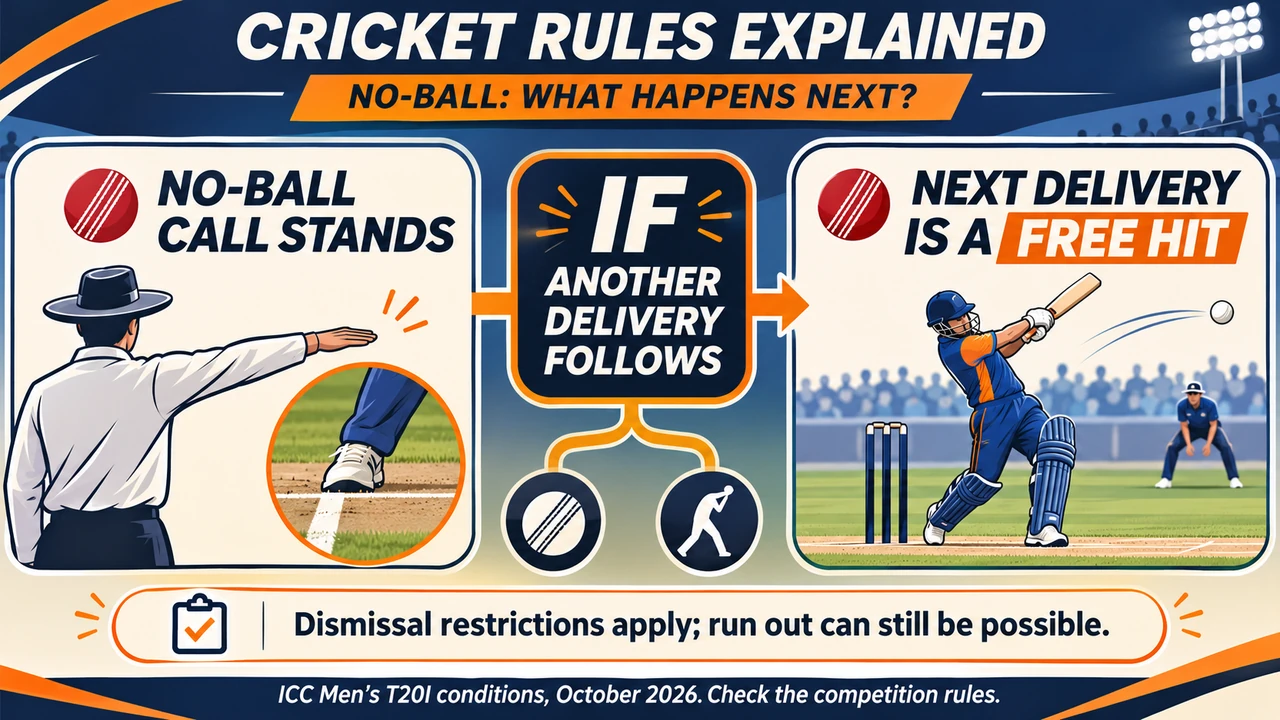
Consider this hypothetical sequence:
- A bowler delivers a no-ball. The batting side receives the no-ball penalty, and the ball does not count as a valid ball of the over.
- The next delivery is the free hit. If that delivery is a wide or another no-ball, the next delivery is also a free hit, if play continues.
- A later legitimate free-hit delivery is hit into the air and caught. The catch alone does not dismiss the striker, although the ball and any running still need to be judged under the applicable rules.
Do not apply this sequence to another format or league until its current playing conditions have been checked. The MCC Laws and an individual competition’s additional conditions are related but distinct sources.
Can a batter be out on a free hit?
Yes. Under the specified ICC men’s T20I conditions, a free hit has the same dismissal restrictions as a no-ball. The permitted modes listed for a no-ball are hit the ball twice, obstructing the field and run out, subject to the requirements of those separate rules. Being caught, bowled or LBW on that delivery alone does not dismiss the striker under those restrictions.
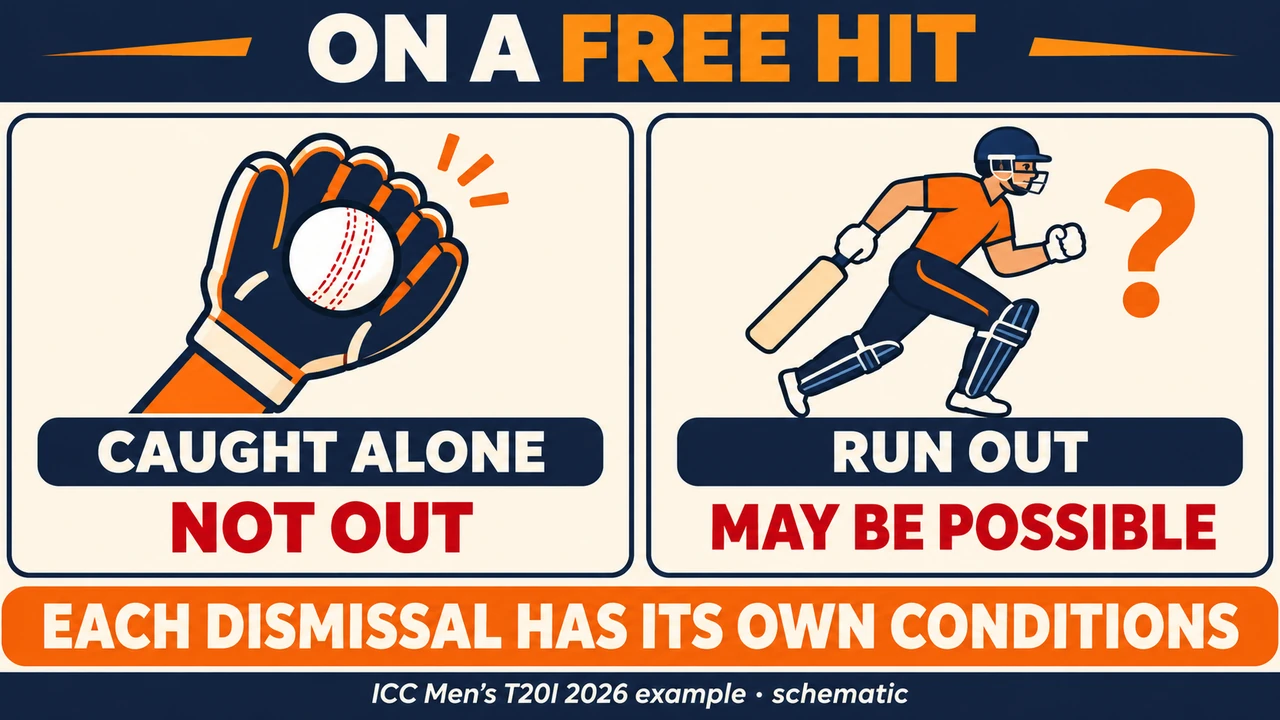
That is why “free hit” does not mean “nothing can go wrong”. If the batters attempt a run, their ground and the state of the wicket can matter. A dismissal cannot be inferred from a label alone: the umpire must assess what actually happened.
Does the field stay the same?
The cited conditions restrict changes to field positions and swapping fielders between positions for a free hit, with specified exceptions. A change of striker is one exception; correcting a fielding restriction breach that caused the no-ball is another, to the extent allowed by the condition. The bowler may change mode of delivery subject to the relevant notification requirement. Check the full clause and the event’s own rules for the details rather than assuming every fielder must always remain in place.
No-ball and free-hit FAQ
Does every no-ball lead to a free hit?
Not in every form of cricket. Under the cited October 2026 ICC men’s T20I conditions, if the no-ball call stands and another delivery is bowled, that next delivery is a free hit. Other competitions may use different conditions or no free-hit provision.
Does a wide cancel a free hit?
Under the cited T20I conditions, a wide on the free-hit delivery causes the free hit to carry to the next delivery, if another delivery is bowled. Check another competition’s rules before assuming the same result there.
Can the batter be run out on a free hit?
Yes, a run-out remains a possible dismissal under these conditions if the separate run-out requirements are met. It is not automatic merely because a fielder breaks the wicket.
Does the free hit have to be faced by the same batter?
No. Under the cited conditions it is for whichever batter faces the next delivery.
For the scorecard around the call, see how to read an IPL scorecard. If the question instead concerns a substitution, the Impact Player guide explains a separate match rule. For an archive of the completed 2026 season and links to official records, see the IPL 2026 season guide.