
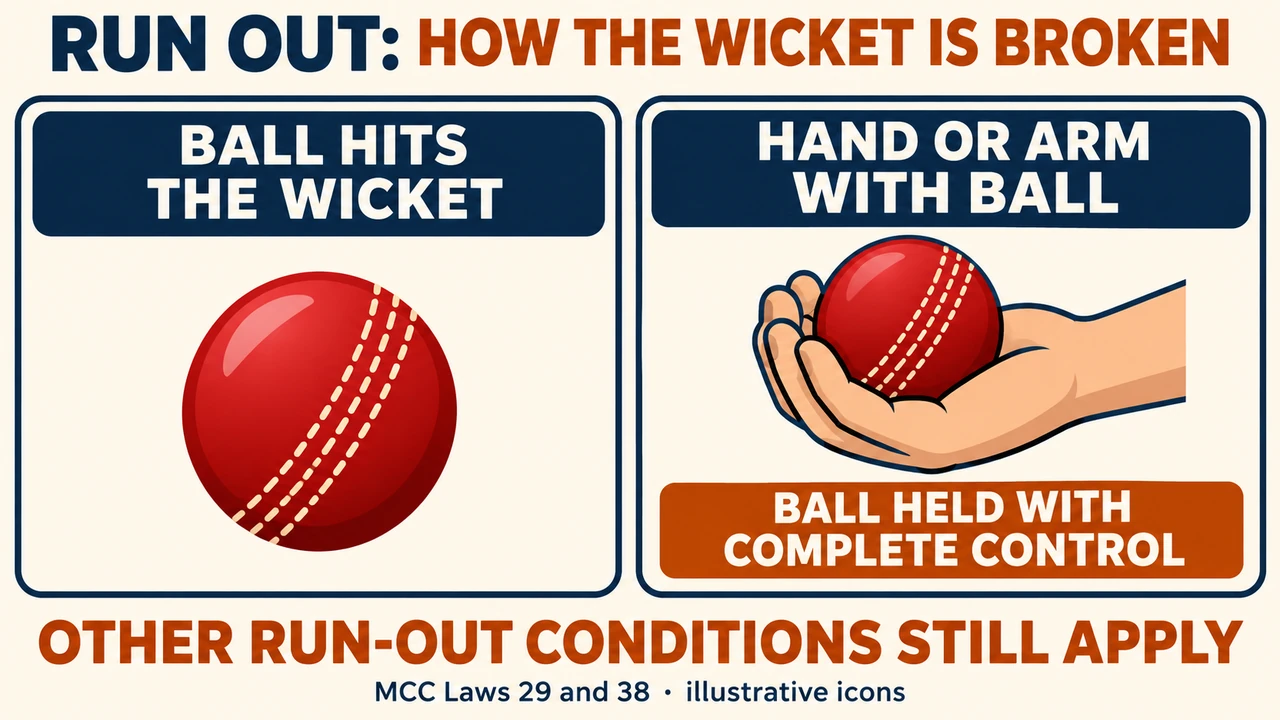
For a run-out appeal, it matters how the wicket was broken. In an October 2026 clarification, MCC explained that the complete-control requirement applies when a fielder breaks the wicket with a hand or arm while holding the ball. A ball can also strike the wicket and dislodge a bail without first being held in that way.
That distinction answers only one part of the decision. The umpire must also consider the batter’s ground, whether the ball was in play, the applicable exceptions and the match’s playing conditions.
When the fielder breaks the wicket with a hand or arm
MCC says the ball must be held with complete control in the fielder’s palm or fingers, or in the palm or fingers of a wicket-keeper’s glove, to be considered held in the hand. Merely touching the ball as the hand or arm breaks the wicket does not by itself establish that control.
The clarification’s held-ball test concerns a fielder using a hand or arm to break the wicket, with the ball held in the hand or the hand of the arm used. A still image of a hand near the ball may not show enough to determine control at the relevant moment; the officials assess the evidence available under the match protocol.
When the ball strikes the wicket
MCC separately explains that a ball can break the wicket by hitting it. With bails in use, Law 29 includes a bail being completely removed from the top of the stumps or a stump being removed from the ground. A throw or deflection can therefore be relevant without a fielder catching and holding the ball first. The requirement to hold it with complete control is not a blanket condition for every run-out. Law 29 has further provisions for a wicket already broken and for play without bails.
Fairly breaking the wicket is still not the whole appeal. For example, Law 38 includes an exception when a ball delivered by the bowler has not contacted a fielder before the wicket is fairly broken. Check the applicable Law and facts instead of deciding an appeal from the contact point alone.
The batter’s ground and timing still matter
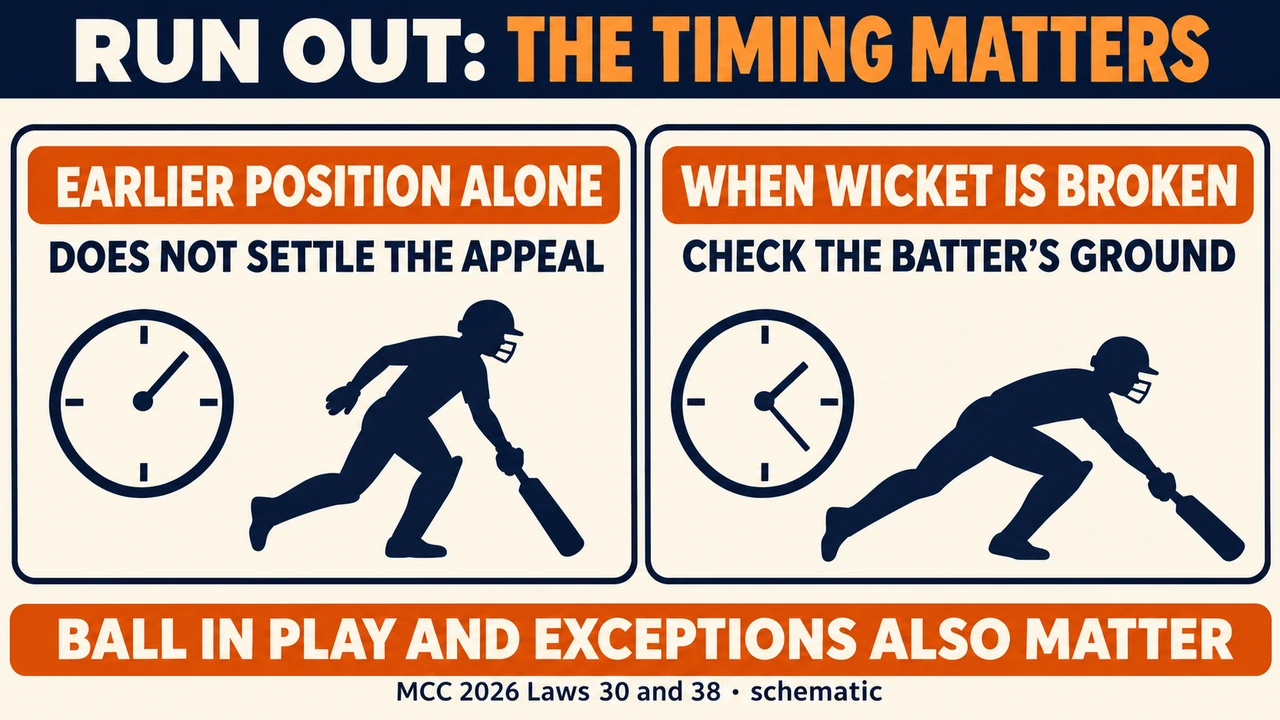
Under Law 38, subject to its exceptions, a batter can be run out if out of their ground while the ball is in play and their wicket is fairly broken by a fielder’s action or by the ball rebounding from a fielder’s person. The timing matters: being out of the ground earlier is not the same as being out of it when the wicket is fairly broken. The Laws also determine which batter’s ground is at that end.
Law 30 contains detailed provisions about being in or out of ground, including circumstances involving a batter running or diving after grounding the bat or person. Do not decide a close case from a general phrase such as “the bat was in the air”; the whole provision and sequence matter.
A practical comparison
Imagine two separate appeals. In the first, a fielder’s hand breaks the wicket while the ball is in that hand. The officials must consider whether the ball was held with the required control. In the second, a ball previously contacted by a fielder hits the stumps and dislodges a bail. The hand-held-ball test is not the same question there.
Neither example automatically makes the batter out. The officials still need the batter’s position, timing and any applicable exception. These are hypothetical examples, not reconstructions of a real match.
The site’s scorecard guide explains how wickets appear in the innings record; the required run-rate guide gives context for a chase. For personal limits and support, see the responsible gaming page.
Run-Out FAQ
Must a fielder catch the ball for every run-out?
No. MCC says the ball can hit the wicket and dislodge the bails. The complete-control definition applies to the specified case of a fielder breaking the wicket with a hand or arm while holding the ball.
Is touching the ball enough when the hand breaks the wicket?
Not by itself. The MCC definition of the ball being held in the hand requires complete control in the palm or fingers, including those of a wicket-keeper’s glove.
Does a ball hitting the stumps automatically mean out?
No. Whether the batter whose ground is at that end is out of it when the wicket is fairly broken, whether the ball was in play and the applicable exceptions also matter.
Does the 2026 ball-control clarification decide every run-out appeal?
No. It addresses how the wicket may be broken, including when a fielder uses a hand or arm while holding the ball. The batter’s ground, timing and applicable exceptions remain separate questions.