
A ball coming to rest on the field does not, by that fact alone, establish that it is finally settled or dead. Under the 2026 MCC Laws, “finally settled” combines the ball’s physical state with a decision by the bowler’s-end umpire that it is no longer in play.
A ball can also become dead in other ways. A boundary, a dismissal and other situations listed in Law 20 have their own provisions. Check the match’s playing conditions and the edition in force.
What does finally settled mean in the 2026 Law?
Law 20.1.2 describes a ball as finally settled once it is either in the hand or hands of any fielder or stationary on the ground, and the bowler’s-end umpire determines that it is no longer in play. Law 20.2 says whether it is finally settled is for the umpire alone to decide.
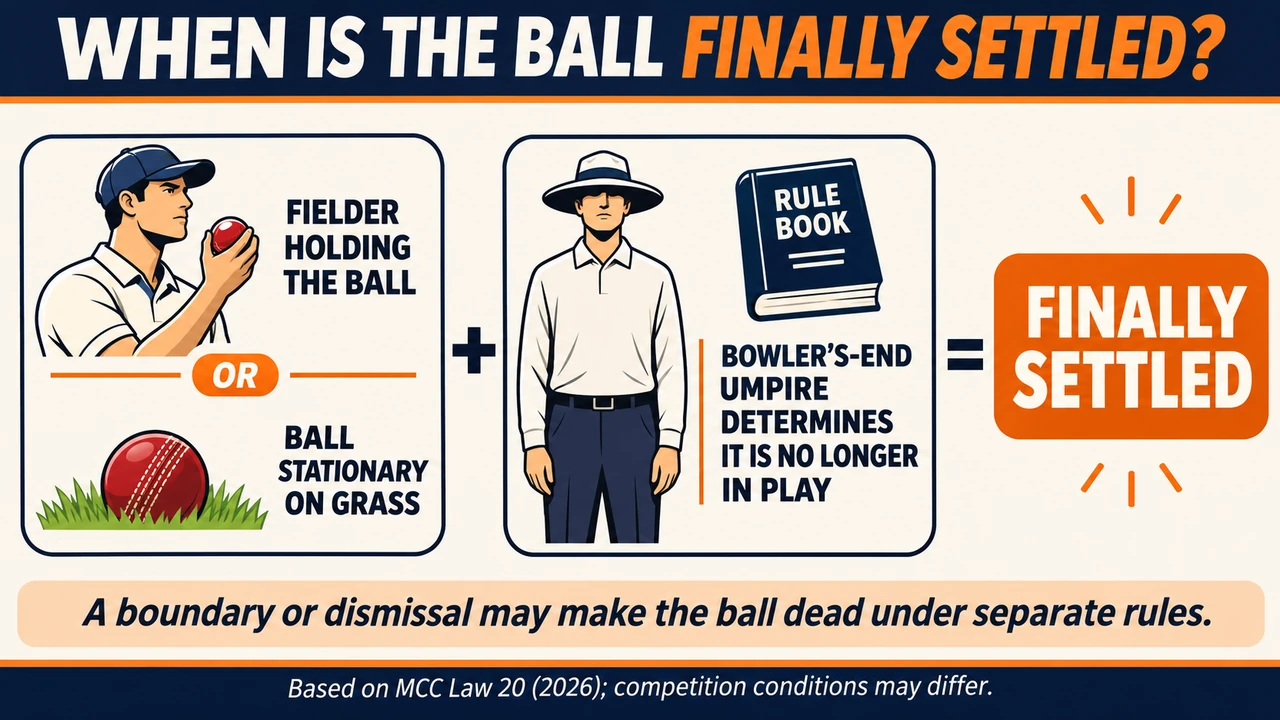
Both parts matter. A stationary ball or a fielder holding it meets a physical condition, but that fact alone does not replace the umpire’s determination. Likewise, a player stopping or saying play has ended is not, by itself, the umpire’s finally-settled determination.
What changed from the earlier wording?
In its explanation of the 2026 changes, MCC said the ball no longer has to be in the bowler’s or wicket-keeper’s hands to be finally settled. It can be held by any fielder or stationary on the ground, subject to the umpire’s decision.
MCC also explained that the change gives the umpire more scope to decide in context, including when one player is still attempting to play on. That does not mean a fielder may safely assume an attempted run-out has ended simply because the ball has briefly stopped moving.
Other ways the ball can become dead
Law 20 lists several situations in which the ball becomes dead, including when a boundary is scored or a batter is dismissed. It also requires an umpire to call and signal Dead ball in specified circumstances. Under Law 20.4.2, the ball is generally considered dead at the incident, but where the Law expressly delays the call, it is dead at the call; scoring depends on the applicable provision. This is not a complete list.
The bowler’s-end umpire may call and signal Dead ball after it has become dead when necessary to inform players. The absence of an immediately visible signal is not, by itself, proof that every possible dead-ball condition is absent.
Is a wide or no-ball automatically dead?
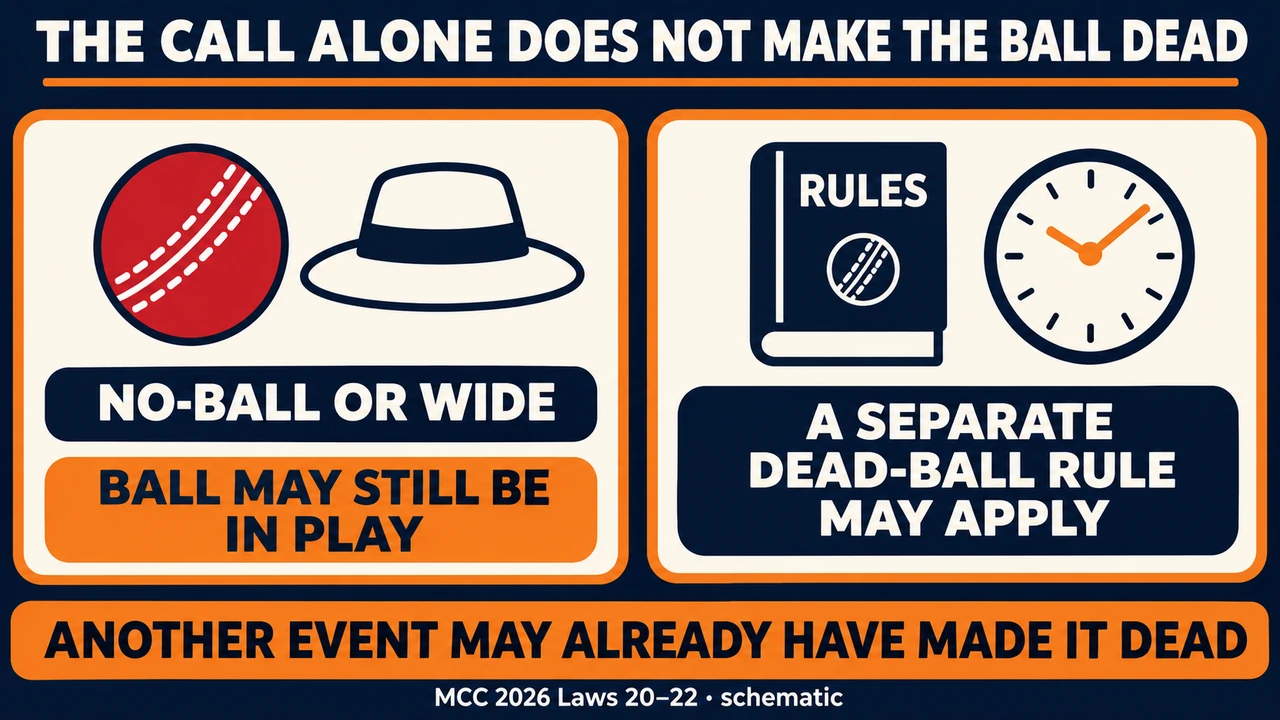
Under MCC Laws 21 and 22, the call of No ball or Wide ball does not by itself make the ball dead. The ball may already be dead, or it may become dead for a separate reason. This distinction matters when interpreting runs and a possible dismissal: the call and the ball’s status are separate questions.
For an individual delivery, follow the umpires and the official scorecard. The site’s scorecard guide explains the surrounding innings record, while the required run-rate guide puts the chase in context. For personal limits and support, see the responsible gaming page.
Dead Ball FAQ
Is a stationary ball automatically dead?
Not solely because it is stationary. For the 2026 Law’s finally-settled definition, the bowler’s-end umpire must also determine that it is no longer in play. It may already be dead for a separate reason, such as a scored boundary.
Must the wicket-keeper hold it for it to be finally settled?
No. The 2026 Law permits the ball to be in the hand or hands of any fielder, or stationary on the ground, together with the umpire’s determination.
Does a wide call make the ball dead?
Not by itself under MCC Law 22. A separate dead-ball provision may apply to the incident.
Is this the only way a ball becomes dead?
No. Law 20 includes other situations, including a boundary and a dismissal, and sets out circumstances requiring an umpire to call and signal Dead ball.