
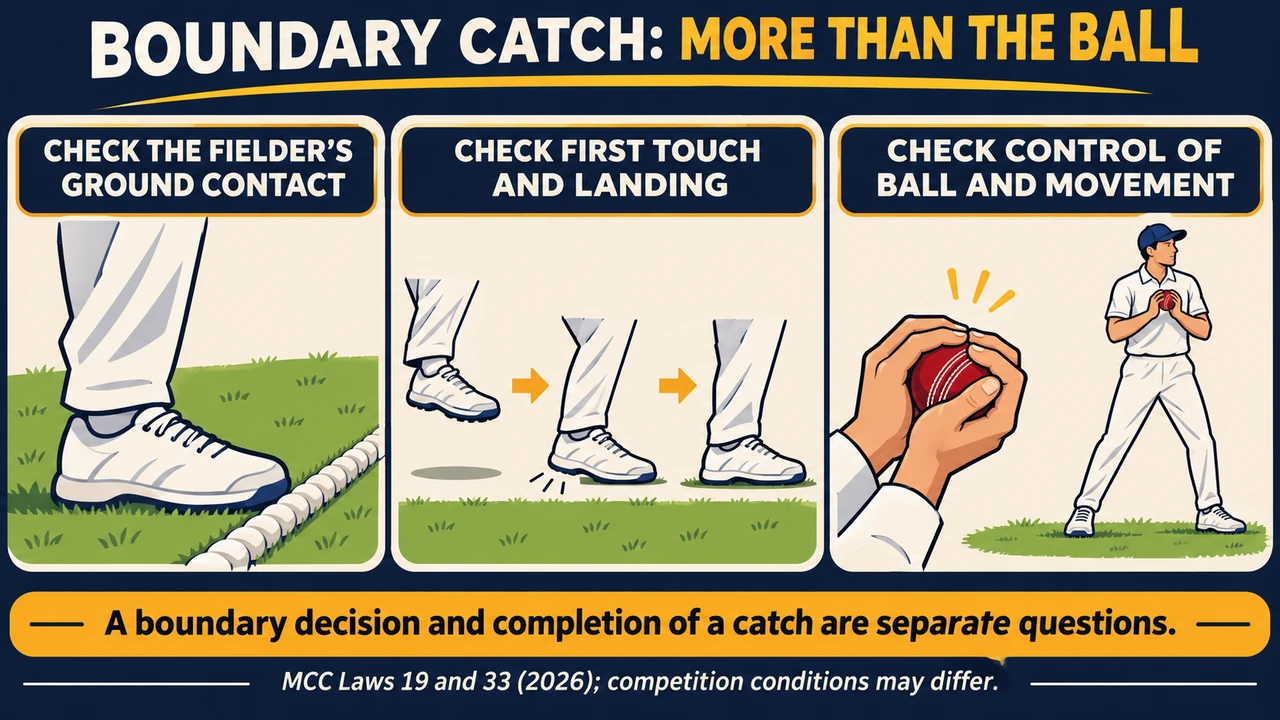
A fielder may take a ball in mid-air near the rope, but the ball’s position alone cannot tell you whether the catch is fair. The 2026 MCC Laws ask about the fielder’s contact with the ground, the boundary and the ball. Separately, the catch must be completed under Law 33.

The following is a guide to that edition of the MCC Laws. A match’s competition conditions may differ, so identify the tournament and rules in force before judging a particular replay.
A fielder can be grounded beyond the boundary without standing outside it
Law 19.5 says a fielder is grounded beyond the boundary if any part of their person touches the boundary or a boundary-marking object, the ground beyond it, or an object in contact with that ground. It also describes a specific case involving contact with another fielder grounded beyond the boundary when the umpire considers either intended that contact to assist fielding the ball.
If a fielder grounded beyond the boundary touches the ball while it is in play, Law 19.4 treats the ball as grounded beyond the boundary. A foot touching the boundary rope places that fielder beyond the boundary for this Law, but a boundary depends on the ball and fielder contacts described above.
The first touch while airborne
For a fielder not in contact with the ground, Law 19.5.2 looks at their final contact with the ground before their first contact with the ball. If that last ground contact was not entirely within the boundary, the fielder is considered grounded beyond it.
The Law applies this first-contact test to each fielder who contacts the delivered ball, even if another fielder touched the ball earlier. In a relay, a valid first touch by one fielder does not establish where another fielder was grounded.
What happens after an initial touch?
The 2026 Law also describes a later airborne action. If the fielder’s first contact did not contravene the first-contact rule, that fielder may then jump from outside the boundary to contact the ball while airborne. After that airborne contact, all subsequent ground contact by that fielder until the ball becomes dead must be within the field of play, whether or not the fielder is still touching the ball; a later ground contact outside during that delivery results in a boundary.
If the fielder who jumped from outside returns the ball to the field of play, the Law specifically requires that fielder to land and remain within the boundary until the ball becomes dead. These steps come with conditions; they do not permit unrestricted repeated jumps from outside.
Avoiding a boundary is not the same as completing a catch
A fair catch also requires that the ball and any fielder touching it are not grounded beyond the boundary before the catch is completed. Officials must then assess control and the other conditions for being caught. MCC has explained that a fielder needs complete control of both the ball and their own movement. A ball held briefly before it is dropped during the act of catching is not enough on its own.
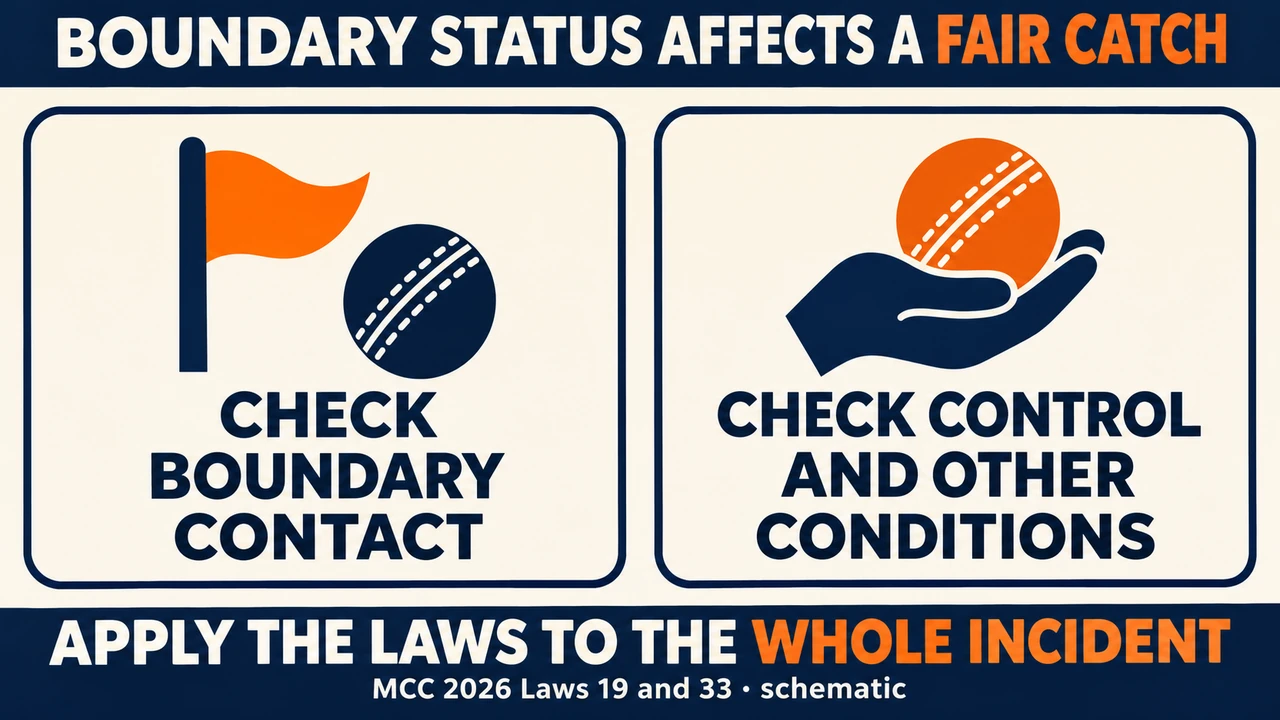
Do not use a single still frame as the entire decision. Depending on the incident, the review may need the fielder’s take-off, contacts with the ball and ground, landing, and control of both movement and ball. The actual match protocol governs what evidence is available and how the decision is made.
The site’s scorecard guide explains how wickets appear in an innings, while its required run-rate guide puts the score in chase context. For personal limits and support, see the responsible gaming page.
Boundary Catch FAQ
Is touching the rope while holding the ball safe?
No. Under Law 19.5, contact with the boundary or its marking object grounds the fielder beyond the boundary. The full sequence still matters when the ball and catch are assessed.
Does the first fielder’s legal touch make a relay catch automatically valid?
No. Law 19.5.2 applies the first-contact ground test to each fielder, whether or not someone else has previously touched the ball. Catch completion must also be assessed.
Can a fielder jump from outside the boundary?
The 2026 Law describes a conditional later airborne contact after an initial contact that satisfies its rule, followed by specified landing and ground-contact requirements. It is not an unrestricted first touch from outside.
Does avoiding the rope prove the catch is complete?
No. The catcher must also satisfy the catch Law, including complete control of the ball and their own movement.