
A ball reaching the boundary after a fielder handles it is not automatically an overthrow. The 2026 MCC Laws distinguish an overthrow from specified attempts to stop the ball or pass it a short distance near the boundary. That classification affects how runs are calculated when a boundary results.
This guide compares the Law 19.8 calculation with the ordinary boundary rule. Check the playing conditions in force for the match: a competition may use its own provisions.
What counts as an overthrow boundary?
Under Law 19.8.2, a boundary results from an overthrow if, in the umpire’s opinion, a fielder directs the ball towards the wickets in an attempt to run out a batter or prevent further scoring, and the ball subsequently crosses the boundary.
Law 19.8.2 excludes a boundary resulting from an attempt to stop the ball, or a short pass to another fielder while fielding near the boundary, from its overthrow definition. A separate wilful act is assessed under that Law’s own definition. The distinction depends on the action and the umpire’s judgement, not merely on whether the ball touched a fielder.
When the boundary is an overthrow
For the batting side, a boundary resulting from an overthrow or the specified wilful act is calculated by adding:
- The applicable boundary allowance.
- Runs the batters had completed when the throw or wilful act occurred.
- The run in progress if the batters had already crossed at that instant.
- Any penalty runs awarded to the batting side.
Any penalty awarded to the fielding side remains credited to that side, not added to the batting total.
Count completed runs and check whether the batters have crossed on the run in progress at the instant of the throw or wilful act, not when the ball later reaches the boundary. The Law also addresses which end the batters return to; scoring a boundary does not remove the need to apply that separate provision.
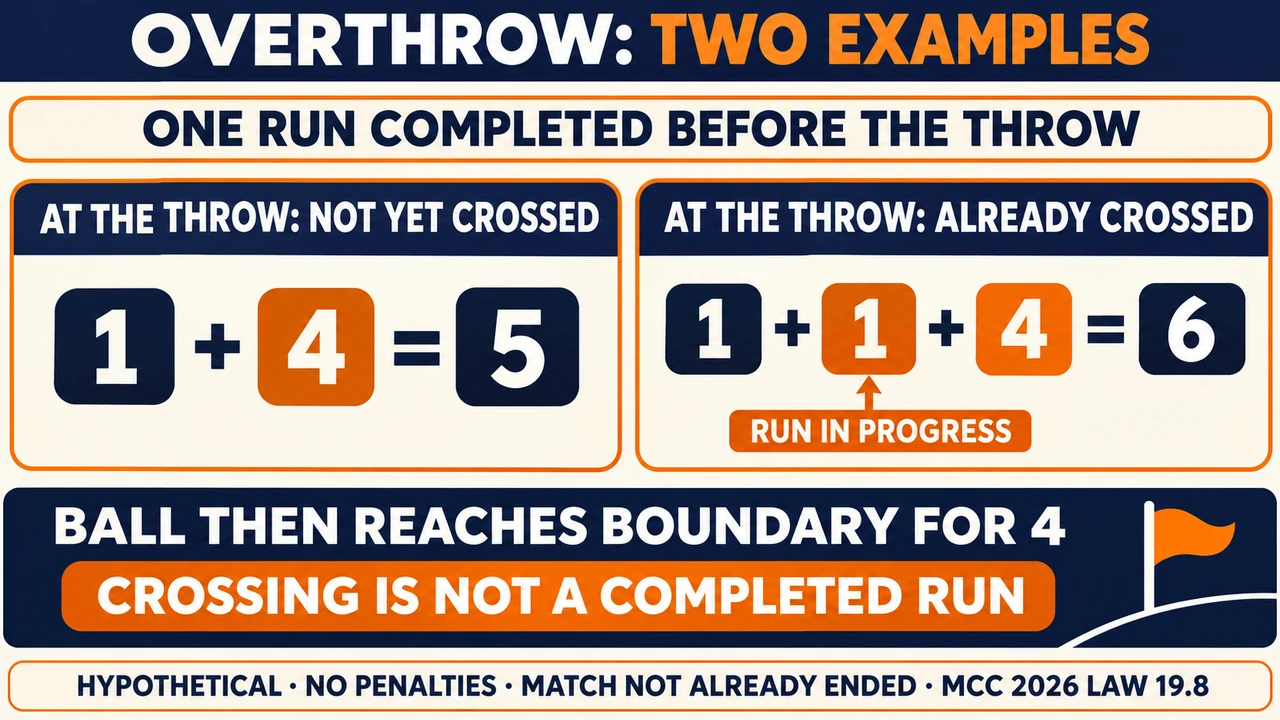
Example: one run completed before the throw
Suppose the applicable boundary allowance is four, the batters have completed one run when a fielder throws towards the wickets, and the resulting boundary is an overthrow. Assume no penalty runs, the match has not concluded before the boundary, and all other relevant conditions are met.
If the batters had not crossed on their second run at the instant of the throw, the calculation is one completed run plus the four-run allowance: five. If they had crossed on that second run at the instant of the throw, that run in progress is also included: six. These are hypothetical calculations, not an assessment of a real incident.
What if it is a misfield instead?
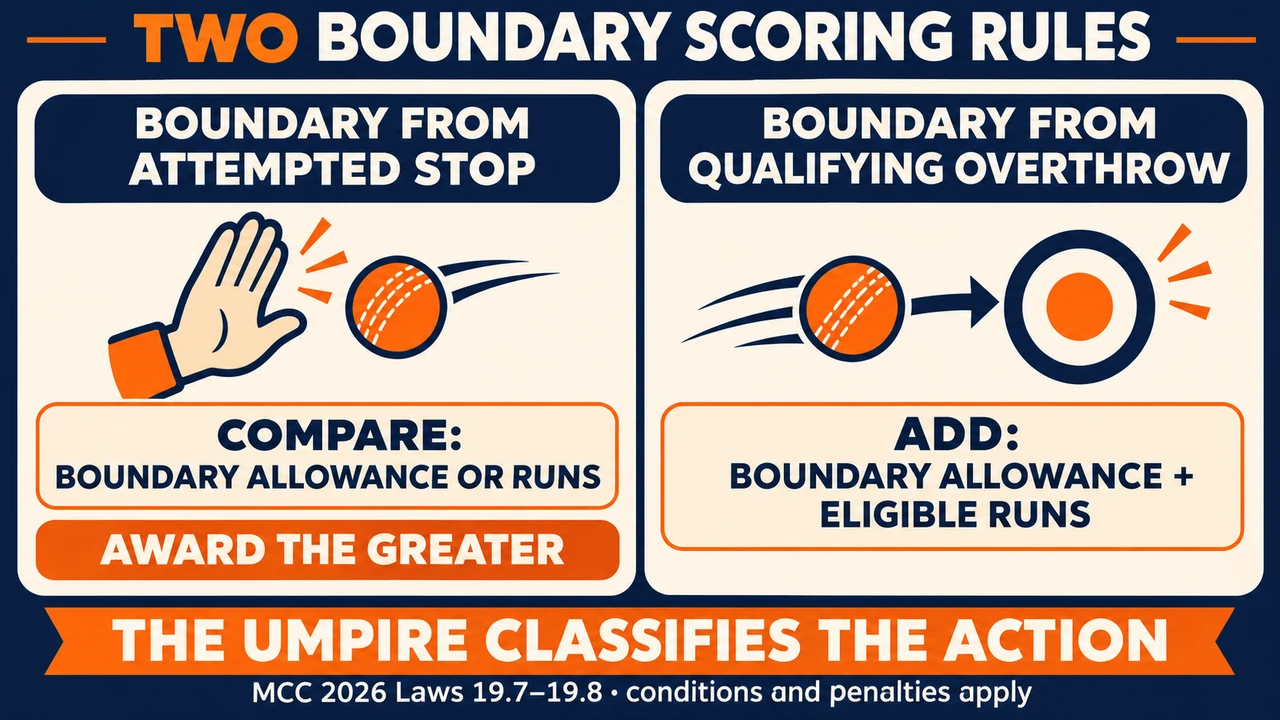
Do not automatically add the completed runs to the boundary allowance just because the ball reached the rope after a failed stop. For a boundary outside Law 19.8, compare the boundary allowance with the runs completed plus the run in progress if the batters had crossed when the boundary was scored; award the greater. Credit any penalty runs to the side awarded them separately.
Notice that the relevant instant differs: Law 19.8 refers to the throw or wilful act, while the ordinary Law 19.7 comparison refers to when the boundary is scored. The umpire decides which rule applies before the score is calculated.
Check the match conditions and scorecard
The ICC’s October 2026 summary also explains the distinction between an overthrow and a misfield. It states that the new international conditions applied to series starting on or after 1 October 2026, while ongoing series continued under the previous regulations. Verify the tournament, start date and current playing conditions before applying this guide to a match.
Use the site’s scorecard guide to place the runs in the innings and the required run-rate guide to understand the remaining chase. For personal limits and support, visit the responsible gaming page.
Overthrow FAQ
Are all boundaries after a misfield overthrows?
No. The 2026 Law excludes specified attempts to stop the ball and a short pass near the boundary from the overthrow definition. The umpire applies the relevant facts and conditions.
Does crossing matter when the throw is made?
For the run in progress under Law 19.8, yes: the batters must already have crossed at the instant of the throw or wilful act for that run to be included. Completed runs are counted separately.
Is an overthrow always worth four extra runs?
No. The applicable boundary allowance and the other runs under the Law determine the total. A boundary allowance of four is used in the example, not asserted as a universal outcome for every match.
Can I apply the 2026 overthrow rule to an earlier match?
Not automatically. Identify the competition, the match and the conditions in force at the time before applying the throw-and-crossing test. The ICC applied its change to international series starting on or after 1 October 2026; series already under way continued under previous conditions.