
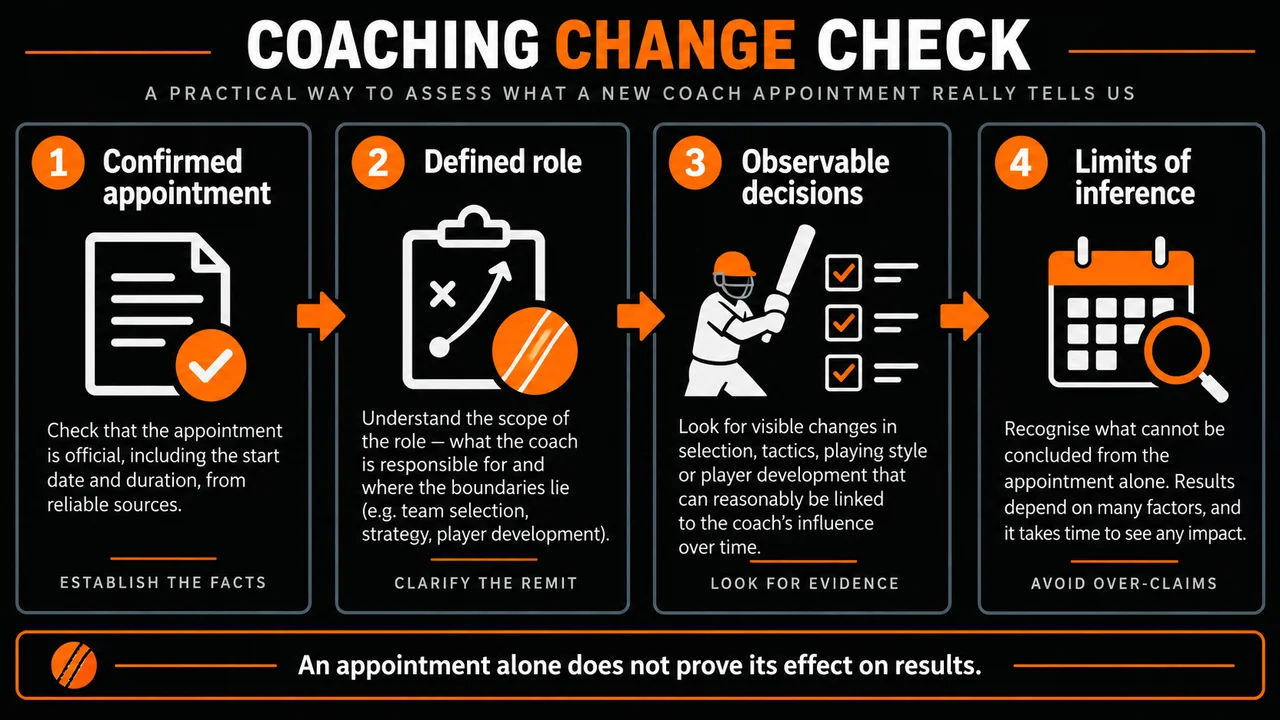
An official appointment tells you who holds the coaching role. A new tactical identity needs further evidence. IPL coaching changes are easiest to assess when you first establish the job, then look for a specific decision the staff described, and finally separate that decision from the match result. This avoids crediting one person for every improvement or blaming him for every defeat.
Reviewed on 4 October 2026. Rajasthan Royals provide a documented example for the 2026 cycle. This is a focused review of official role descriptions and one reported tactical decision, rather than an unverified list of changes across all ten teams.
The appointment and the staff page answer different questions
Rajasthan Royals’ 17 November 2025 announcement confirmed Kumar Sangakkara’s return as head coach while he continued as Director of Cricket. It also named the supporting coaching group. The dated announcement establishes the appointment; the current support-staff page provides another view of listed responsibilities.
| Person | Dated appointment notice | Staff-page label checked 4 October 2026 |
|---|---|---|
| Kumar Sangakkara | Head coach and Director of Cricket | Head Coach and Director of Cricket |
| Vikram Rathour | Lead assistant coach | Batting Coach |
| Shane Bond | Fast bowling coach | Fast Bowling coach |
| Trevor Penney | Assistant coach | Assistant Coach |
The Rathour labels are not identical. Preserve both with their source dates instead of silently choosing one as a permanent title. A profile page can use a shorter specialism label while a press release describes a senior position. These records do not, by themselves, show whether the underlying duties changed.
Look for a decision the coach actually discussed
In a 25 May 2026 franchise report, Sangakkara explained Jofra Archer’s promotion to No. 7 against Mumbai Indians. The report records Archer’s 32 from 15 balls and the batting-order move. This is a concrete decision with named participants and an innings context, unlike a claim that a coach introduced a winning mentality.
The example supports a limited conclusion: the side used a specific batting promotion and the coach publicly discussed it. It does not establish that the same promotion works against every attack. Nor can one successful innings prove that a staffing change caused a whole season’s performance. The opposition, wickets remaining, batters available and deliveries left all shaped the situation.
Who owns the decision?
Public reporting rarely gives a complete record of every discussion between analysts, coaches and the captain. If the coach explains a decision, attribute the explanation to him. If the captain discusses it at the toss or after the match, identify that source separately. Avoid turning a team decision into an exclusive personal invention when no source establishes who proposed or approved it.
| Observation | Reasonable interpretation | Evidence still needed |
|---|---|---|
| Official appointment | Person held the announced job from that notice | Later changes to responsibilities |
| Explained batting promotion | A specific tactical choice was made | Whether it became a repeatable approach |
| Better results after an appointment | Results followed the change in time | Evidence separating staff influence from other changes |
Compare decisions over several matches
To examine whether a new approach persisted, record the same variables across matches: batting order, bowling phases, substitutions, availability and opposition. A repeatable selection pattern is more informative than a single memorable win. Include counterexamples. If a batter returned to his usual position next game, that may indicate a situational choice rather than a permanent change.
A team can alter its XI because a player is injured, because an overseas place is needed elsewhere, or because conditions favour another option. Those explanations may overlap with a coach’s plan. Record the reason actually stated and leave unstated motives open. Describing uncertainty precisely makes the analysis stronger than assigning a personality trait to every selection.
Check which players could carry out the plan
The IPL team review identifies the playing roles available. The player review deals with opportunities and performance. Use those records to ask whether the staff had the personnel to execute the described choice. Keep a coach’s job title, a player’s ability and a captain’s match decision as related but separate facts.
If you compare periods before and after an appointment, use the same competition and a stated match window. Do not compare a short run of favourable venues with a full previous season and call the difference an effect of coaching. A before-and-after table can describe a pattern, but it cannot control every change in roster, fitness or opposition.
For the Royals example, check three things: the appointment date, the stated role and the batting promotion the coach discussed. It gives readers something they can check. Coaching news should not be used to promise wins, predict guaranteed player output or claim a betting advantage before the underlying cricket evidence exists.
Editorial method: AI-assisted source review checked official records on 4 October 2026. Tables distinguish documented facts from questions still requiring match or event evidence. No first-hand player, coaching or ticket-purchase experience is claimed.