
An LBW review can end with the original decision standing even when the tracking display shows a marginal result. Under the ICC Men’s T20 World Cup 2026 DRS protocol, the relevant category is called Umpire’s Call. In the specific circumstances described by that protocol, the decision can stay unchanged without the review counting against the team’s unsuccessful-review limit.
Those are two separate outcomes: what happens to the batter’s decision, and what happens to the team’s allowance of unsuccessful Player Reviews. The example below uses that named tournament’s rules; other competitions and editions may differ.
Start with the decision on the field
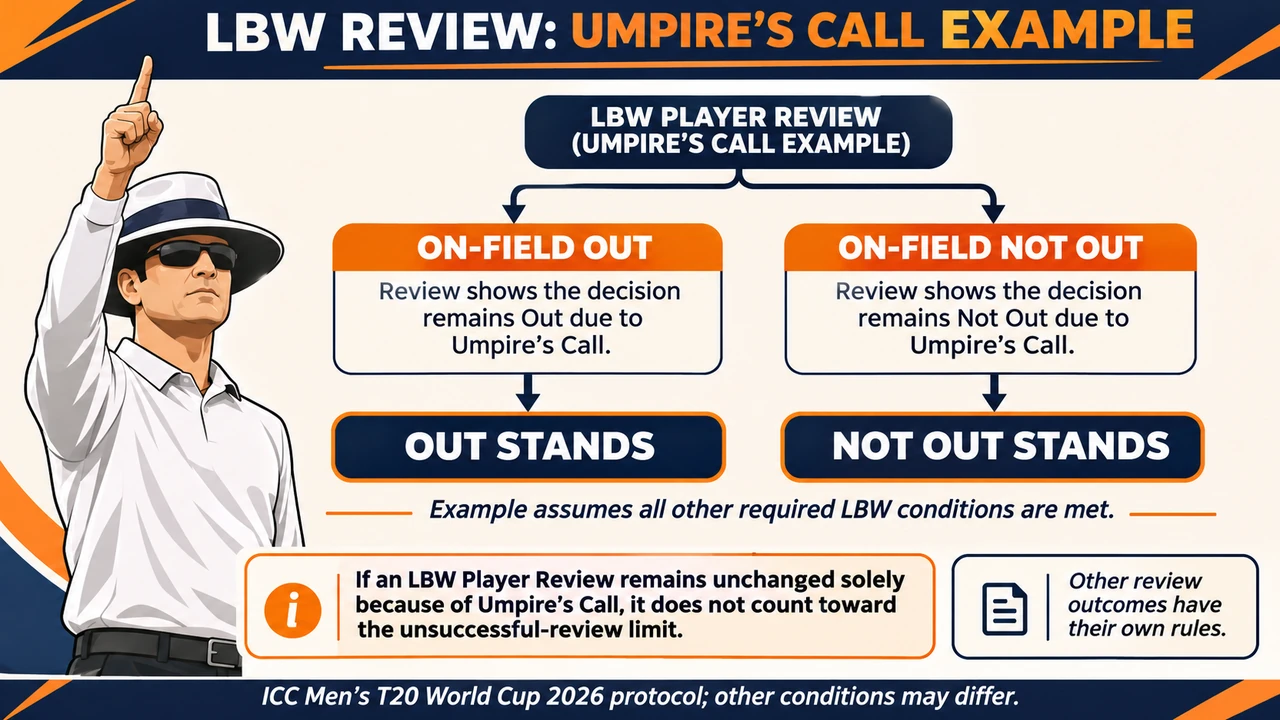
The on-field umpire first gives the decision being reviewed. In the cited protocol, ball tracking may report Umpire’s Call on impact or the wicket projection. The third umpire also checks delivery legality, bat contact and applicable pitching conditions before the final decision.
Consider a simplified example in which the wicket projection is the only unresolved check and all other applicable LBW conditions are satisfied:
- If the original decision is out and the wicket projection is Umpire’s Call, the out decision stands in this example, provided all other dismissal conditions are satisfied.
- If the original decision is not out and the wicket projection is Umpire’s Call, the not-out decision stands in this example, provided all other dismissal conditions are satisfied.
The same marginal category can therefore leave different final decisions because the starting decisions differ. A single tracking image is not enough to judge every condition in an LBW appeal.
Does the team lose a review?
The 2026 tournament protocol states that a Player Review of an LBW decision, unchanged solely because of Umpire’s Call, is categorised as “Unchanged – Umpire’s Call” and does not count toward the innings limit for unsuccessful Player Reviews.
That is narrower than saying every unchanged decision preserves a review. The same protocol generally counts an unchanged decision as unsuccessful, while listing specific exceptions. Its allowance is two unsuccessful Player Reviews per team per innings; do not assume the same number applies to another competition.
Player Review and Umpire Review are different
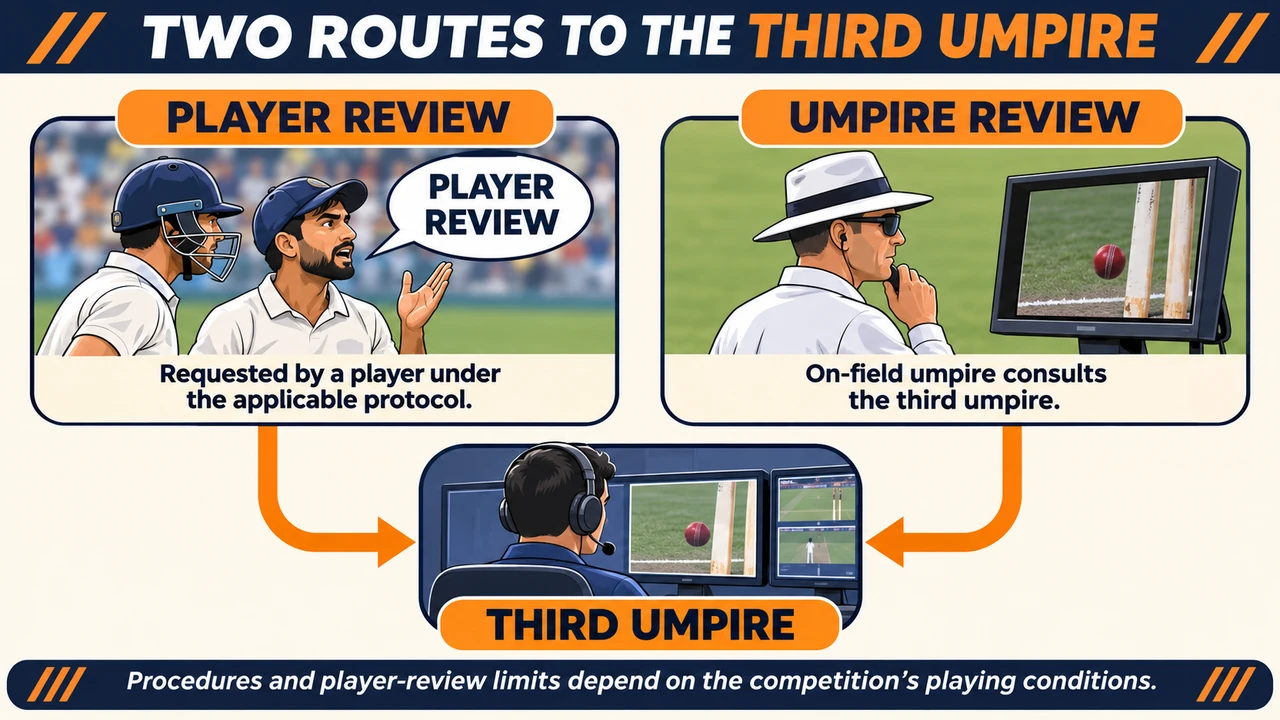
The ICC DRS overview distinguishes a Player Review, requested by a player under the applicable protocol, from an Umpire Review initiated by an on-field umpire. The terms should not be used interchangeably when discussing a team’s remaining Player Reviews.
The 2026 protocol also has specific treatment for some other outcomes, including a no-ball finding that leaves an original not-out decision unchanged without further evaluation. The actual category depends on the full review and the governing conditions, not only the final word shown on a broadcast graphic.
What to check on a live broadcast
Read the on-field decision first. Then check what the review examined, the third umpire’s conclusion and the official remaining-review count. Look up the playing conditions for that tournament and format if the display is unclear.
The site’s scorecard guide explains how wickets and innings information are displayed; the cricket data guide covers context when reading player figures. Neither replaces the match’s DRS protocol. For personal limits and support, see the responsible gaming page.
Umpire’s Call FAQ
Does Umpire’s Call mean the batter is always not out?
No. In the simplified example above, a final Umpire’s Call leaves the original decision standing: an original out stays out, while an original not out stays not out.
Is a review retained whenever the original decision stands?
Not necessarily. In the cited 2026 protocol, the LBW decision must remain unchanged solely because of Umpire’s Call for that specific category not to count against the unsuccessful-review limit. Other categories have their own conditions.
Are Player Reviews and Umpire Reviews the same?
No. The ICC describes them as different routes to the third umpire. The relevant playing conditions determine the procedure and how a Player Review is counted.
Is the 2026 World Cup allowance universal?
No. The cited tournament protocol is a specific example. Check the conditions in force for the match you are watching.