
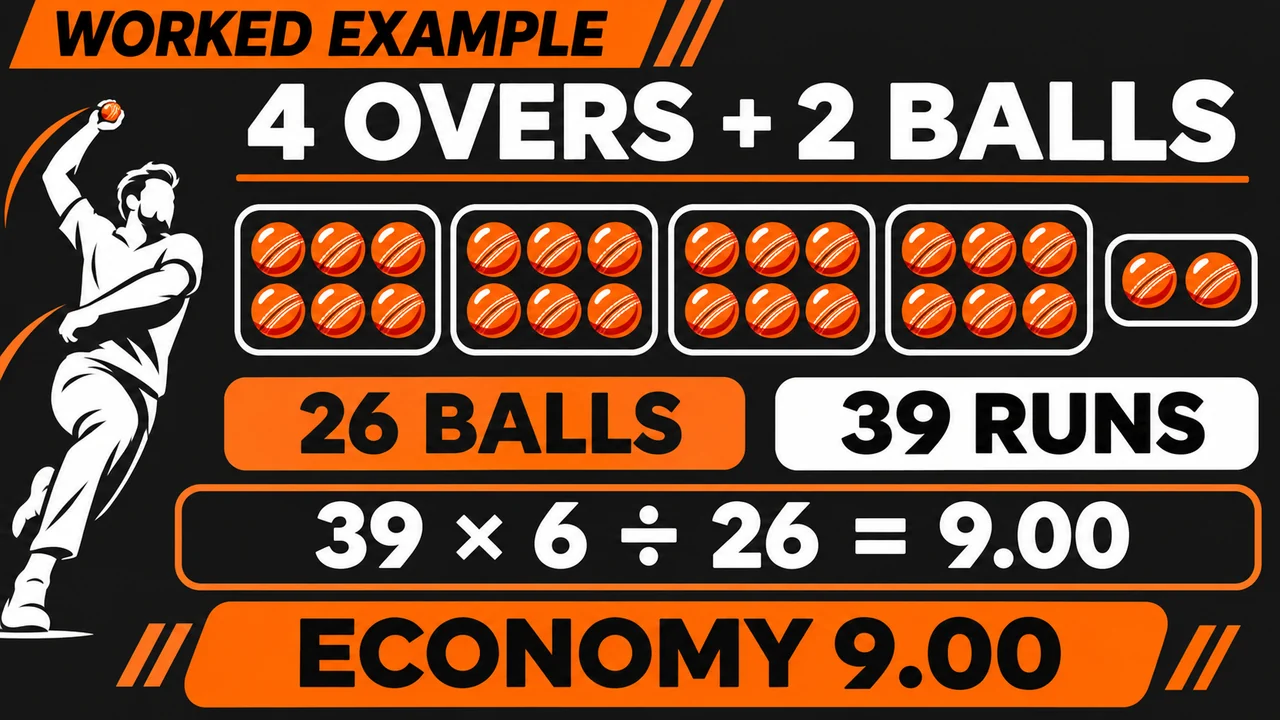
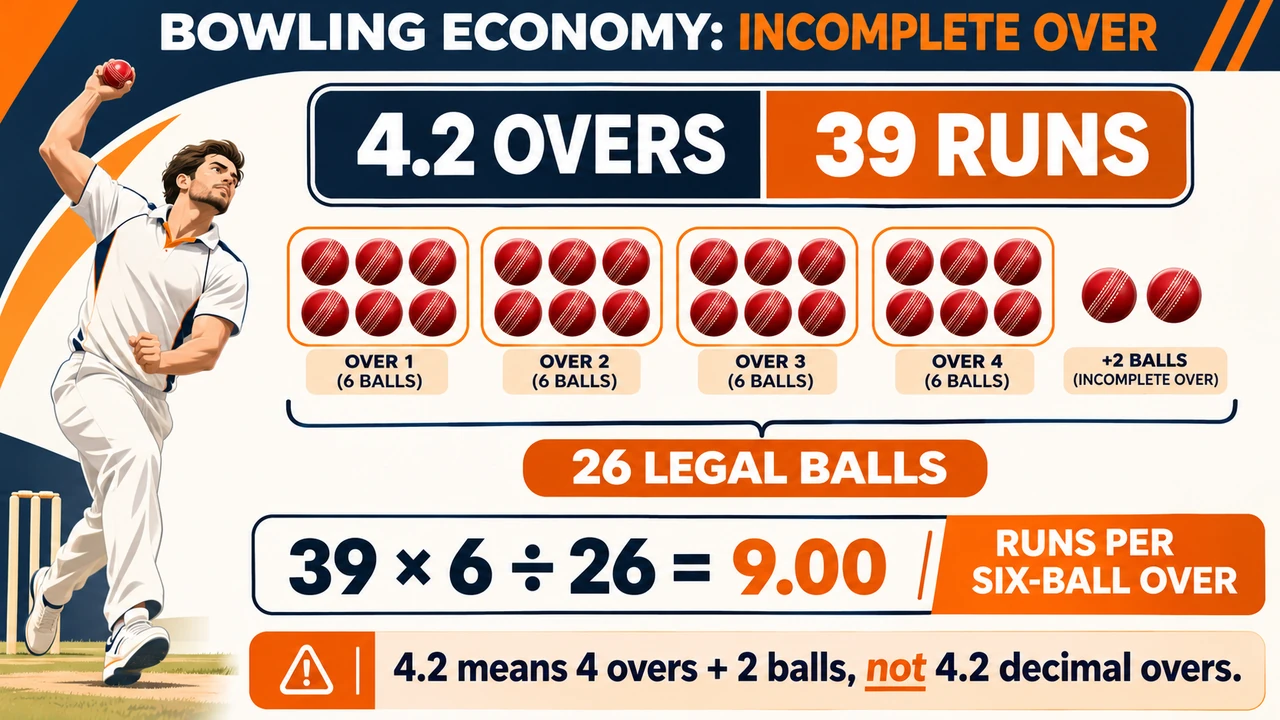
A bowler’s figures say 4.2 overs, 39 runs conceded. Dividing 39 by 4.2 gives the wrong economy rate because the “.2” means two valid balls, not two tenths of an over. If each completed over contained six valid balls and the scorer uses ordinary notation, 4.2 represents 26 valid balls. The calculation is 39 × 6 ÷ 26 = 9.00 runs per over.
That is a rate for the deliveries recorded, not a forecast of what would happen in the next over. Before comparing two bowlers, check the competition’s scoring rules, the runs debited to each bowler and the match context.
Convert overs into balls first
A completed six-ball over normally contains six valid balls. Scorecards use the number after the dot to show the balls in the incomplete over: 4.1 means four overs and one ball; 4.5 means four overs and five balls. In an ordinarily counted six-ball over, the next valid ball completes the over, so the score becomes 5.0 rather than 4.6.
For the example above:
- Four complete overs: 4 × 6 = 24 valid balls.
- Two more valid balls: 24 + 2 = 26 balls.
- Runs charged to the bowler: 39.
- Economy: 39 × 6 ÷ 26 = 9.00 runs per six-ball over.
Treating 4.2 as a decimal would produce approximately 9.29, a different and incorrect result. For a calculator, use 4 + 2/6, or 4⅓ overs, approximately 4.333 decimal overs; then 39 ÷ 4⅓ also gives 9.00.
This method assumes the scorecard’s notation corresponds to the standard six valid balls per over. The MCC Laws set out the rules for valid balls and also address an umpire’s miscount. Use the official scorecard and the applicable playing conditions rather than silently rewriting the recorded match.
Which runs belong in the calculation?
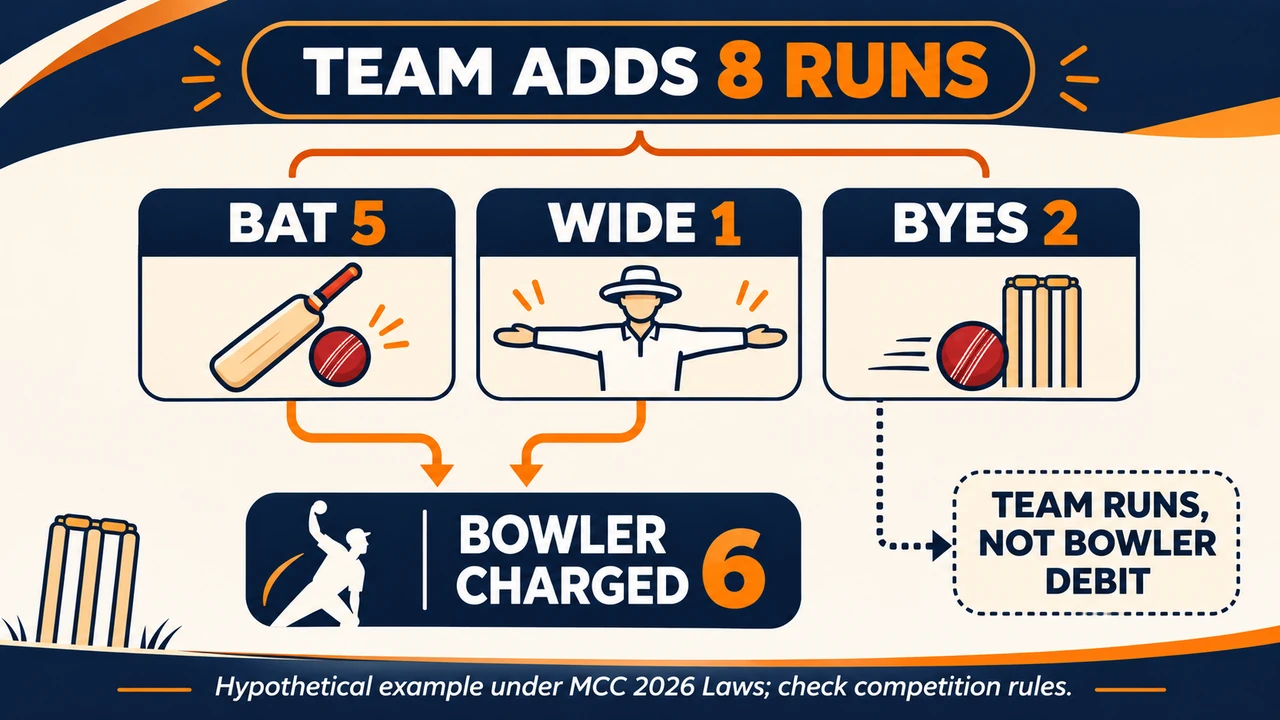
Use the runs debited to the bowler in the bowling analysis, not every run added to the team’s total during that spell. Under MCC Law 18.10, the bowler is debited with runs scored by the striker, no-ball extras and wides; byes and leg-byes are recorded as extras but are not debited to the bowler.
For a simple hypothetical over, suppose the batting side adds eight runs: five from the bat, one wide and two byes. The bowler is charged six runs, while the team receives eight. If this over has six valid balls, its contribution to the bowler’s figures is 1.0 over and six runs; the overall economy still depends on the rest of the spell. The wide adds a run to the bowler’s debit but is not one of the six valid balls.
Penalty runs and unusual scoring events need their specific Laws and playing conditions checked. If the official scorecard already supplies a bowling debit, start there instead of reconstructing a more complicated event from a cropped social-media graphic.
Compare figures without losing the match context
An economy rate describes runs conceded per over; it does not explain every reason for the result. A bowler used for one over at the end of a chase has a smaller sample and a different assignment from a bowler who completed four overs across several phases. Wickets, opposition, field restrictions and conditions can matter to the cricket analysis, but none changes the arithmetic above.
When comparing two figures, write down:
- The competition, match and date.
- Valid balls and runs charged to each bowler.
- The match phase and role, if the source supports them.
- Any missing scorecard detail or different rule set.
The site’s player-data guide gives a broader way to read sample and role. The IPL scorecard guide covers the other fields around the bowling line.
If you are placing economy beside other measures, the cricket data tables guide discusses comparing like-for-like samples rather than ranking players from one figure alone.
Bowling economy FAQ
Is 4.2 overs the same as 4.2 decimal overs?
No. Under ordinary six-ball scoring it means four complete overs and two valid balls, or 4⅓ overs (approximately 4.333 decimal overs).
Do wides count as balls in the over?
Normally a wide does not count as a valid ball of the over, although wide runs are debited to the bowler. Check the recorded scorecard and applicable playing conditions for the match.
Do byes and leg-byes raise the bowler’s economy?
They add to the batting side’s total but are not normally charged to the bowler under MCC Law 18.10. Use the bowling analysis, and check the exact scoring decision if a record looks inconsistent.
Can one over establish that a bowler is more economical?
It establishes a rate for that over; it does not settle a broader comparison. The number of valid balls, role, phase and conditions determine how much context the reader has.
What if no valid balls have been recorded?
There is no valid-ball denominator for this calculation. Do not divide by zero or present a calculated rate; check the official record and how the competition displays that situation.